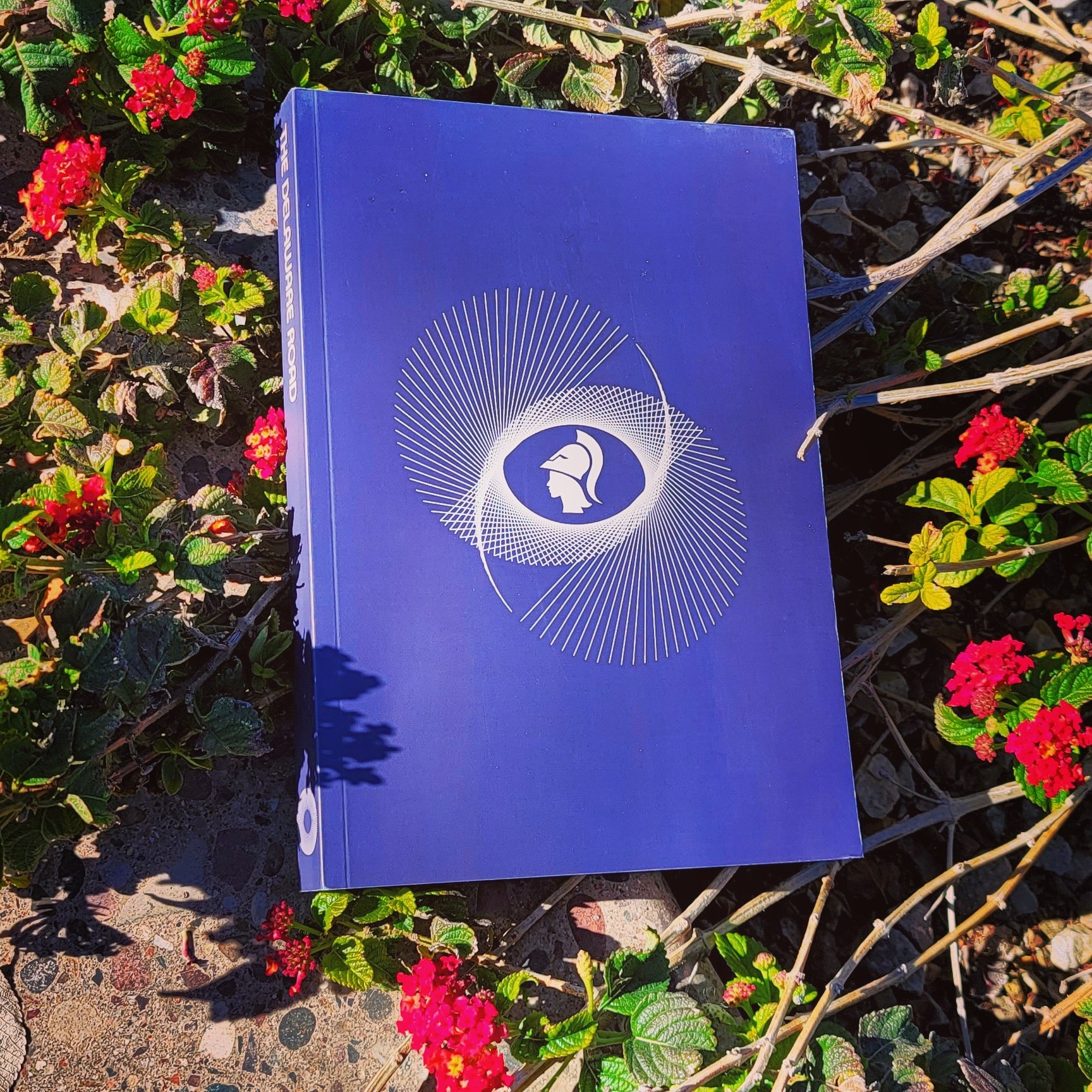
The Delaware Road by Alan Gubby

a rare book review but if you like folk horror, hauntology and the BBC Radiophonic Workshop then you need this..

A gripping tale of an alternative timeline where the government performed occult rituals in BBC Basements during World War 2 and the BBC Radiophonic Workshop (or rather their equivalent in this timezone) discover the tapes to devastating consequences.

The format is very unique, the story presented as a film script on the left page and illustrated on the right. The design and illustration is outstanding with every page demanding your eyes embrace it yet it never clashes with the film playing in your head, serving as a sort of leader for your imagination.

There’s also plenty of prefaces and appendices as Gubby began by telling this story through multi-media performances including a night in a bunker and an actual festival on an active military base. All this is presented with flyers, event photos and even schematics. Very handy context for those of us who never had a hope in hell of attending.

There’s a lot going on in this story. A central thread being the BBC Radiophonic Workshop and with most central characters being analogous to actual composers who worked at the Workshop, though you don’t need to know anything about the Workshop to enjoy the story [however, if you would like to know more then you should read my book!]. Then you’ve got witch cults, haunted electronics, cursed recordings and soundwaves as a means to revolution with some sex and violence thrown in too (not at the same time). 

All that draws a Venn diagram of pertinent themes with ‘The Delaware Road’ right in that perfect sweet spot at the center. It would make one hell of a movie, for sure, but it also works great in this format. I practically inhaled it, only stopping to read due to the demands of work and life. 

My copy even came stunningly wrapped in printed paper with art prints and postcards and radiation pills. The strong visual aspects echoing the multi-media origins of the tale. Once you’ve consumed the story, the book’s stunning visual aesthetics means you’ll still not be letting it go and enjoying a flick through the art many a time. I suspect I’ll be lured back in to reading it all again by that art in the none too distant future.

I mostly buy ebooks these days due to space constraints but this was one I had to have a physical copy of on my shelf and if you’re the sort of person who reads this website, I suspect you need one too.

Remembering John Peel

I have just finished this book and I am left feeling very emotional by it. How can I begin to explain how important John Peel was to me? As a lover of music, his show educated me so much and he opened my eyes to so many styles of music throughout my life. As a broadcaster, you knew he was being his own self. As a person, he seemed to me incredibly endearing, humble and witty.

I still remember where I was when I heard the news. I was in a car with Boo, who I work with in my day job at Alive magazine, delivering our rather fine gig guide to Saltaire, near Bradford (little did I know at the time that this was where his wife Sheila was from). My Ryan Adams tape had just ended, so I pressed eject and caught the last few moments of a song before Colin Murray announced that they had some very sad news. I was surprised at just how much it upset me. I’d always been a bit disdainful of the public displays of grief over the death of Princess Diana, but there I was utterly shocked and upset over the death of a man I never knew.

So, this is the book John was working on when he died. What can I say? John’s part of the book is pure John. You can hear his voice in your head as he tells you his life story. It is everything you would want it to be – moving, engrossing, unpretentious and very funny. His widow Sheila and their children all got together to research the rest of his life and then Sheila finished the book off. My heart goes out to his family for this and I must express my strong gratitude for what must have been a very difficult labour of love.

No-one else could have finished this book other than Sheila and John’s dry sense of humour and skill with an anecdote appear to have rubbed off on her very well. In fact, this approach benefits the book, as John managed to cover most of his life before Sheila and getting a different point of view for the second half somehow adds to the books feeling of authenticity.

Never does the book get boring at any point. It is touching, sad, very funny and full of wonderful anecdotes. Anything other than a wonderful book would, quite frankly, have been unacceptable but between them, John & Sheila have managed to deliver the book that had to be written and that we needed to read. Now all we need is that young buck John always feared would suddenly turn up and take his place to finally materialise [2020 note – still waiting].